Supply chain control is the ability to manage how goods, documents, costs, operational activities, and business information move from one step to another. In logistics, a supply chain is not only about transportation. It includes quotations, bookings, shipments, transport jobs, driver activities, service execution, accounting records, invoices, and reporting.
As logistics operations grow, information often becomes scattered across spreadsheets, emails, messaging applications, and separate department systems. This creates visibility gaps that slow down decision-making and increase operational risk. A structured supply chain workflow helps logistics companies maintain visibility across departments and improve operational coordination.
What Is Supply Chain Control in Logistics?
Supply chain control refers to the ability to monitor and manage operational activities, documents, costs, and responsibilities throughout the logistics process.
For freight forwarding companies, supply chain control may involve customers, carriers, overseas agents, customs service providers, trucking vendors, warehouses, documentation teams, and accounting departments.
For transport companies, supply chain control may involve shippers, consignees, depots, ports, dispatchers, drivers, vehicles, trailers, workshops, and finance teams.
The goal is not only to move cargo successfully. The goal is to ensure every operational update remains visible and traceable throughout the workflow.
Why Is Supply Chain Visibility Important?
Supply chain visibility is important because logistics operations depend on accurate and timely information.
A shipment may be delayed because a document is missing. A transport job may require reassignment because equipment becomes unavailable. A customer may request an updated delivery schedule. If information is stored in multiple locations, teams spend more time searching for updates than solving problems.
Better supply chain visibility helps logistics companies:
- Reduce operational delays
- Improve customer communication
- Detect exceptions earlier
- Improve billing accuracy
- Reduce manual follow-up between departments
- Support faster decision-making
Visibility becomes increasingly important as shipment volume, transport jobs, and customer requirements grow.

Which Logistics Processes Need Supply Chain Control?
Supply chain control should cover every major logistics workflow.
Customer and Quotation Management
Customer records, quotations, service scope, route information, pricing data, and operational requirements should remain connected throughout the workflow.
Incomplete handovers between sales and operations often create service delivery problems later.
Shipment and Service Execution
Shipment records should include booking information, shipment status, service activities, operational milestones, documentation requirements, and customer updates.
Each shipment should remain connected to related services, operational costs, and billing records.
Transport Planning and Execution
Transport operations require visibility into jobs, schedules, dispatch activities, driver assignments, equipment status, proof of delivery, waiting time, and trip completion status.
Without operational visibility, dispatch teams struggle to respond to daily changes.
Accounting and Financial Control
Operational records should connect directly with invoices, receivables, payables, costs, revenue, and profitability reports.
This helps accounting teams reduce manual reconciliation and improve billing speed.
How Does Apollogix FMS Support Supply Chain Control?
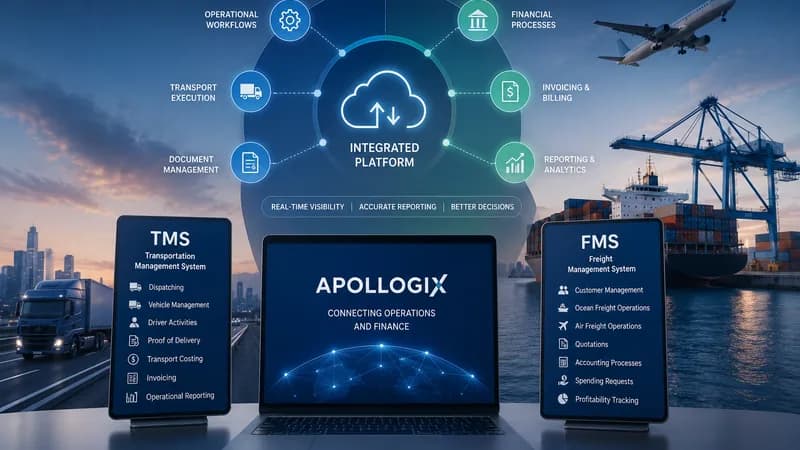
Apollogix FMS helps freight forwarding companies manage operational workflows from quotation to accounting.
The system supports:
- Client Management
- Quotation
- Job Order
- Booking
- Shipment
- Service Management
- Costing Rate
- Accounting
- Spend Money Request
- Reports
By connecting these workflows, freight forwarders gain visibility into shipment activities, service execution, costs, revenue, and profitability.
How Does Apollogix TMS Support Supply Chain Control?

Apollogix TMS helps transport companies control daily transport execution through connected operational records.
The system supports:
- Transport Job
- Operation Planning
- Driver App
- Equipment Management
- Faulty Report
- Maintenance
- Accounting
- Dashboard
- Reports
This allows dispatchers, drivers, workshop teams, accounting teams, and management to work from the same operational data.
Which Supply Chain Risks Should Management Monitor?
Management should focus on workflow handover points because they create the highest operational risk.
Common risk areas include:
- Quotation to Job Order handover
- Job Order to operational execution
- Shipment completion to billing
- Cost recording delays
- Missing documentation
- Equipment availability issues
- Driver reporting delays
- Invoice preparation delays
The earlier these exceptions become visible, the easier they are to resolve.
When Should a Logistics Company Improve Supply Chain Control?
A logistics company should improve supply chain control when:
- Teams repeatedly ask for status updates
- Operational data exists in multiple files
- Reports require manual consolidation
- Invoices are delayed after job completion
- Cost tracking becomes difficult
- Management lacks real-time visibility
- Customer update requests increase
These indicators suggest that operational workflows have become too complex for manual coordination.