What Is Logistics and Supply Chain Management?
Logistics and supply chain management work together to ensure that products, information, and financial transactions move efficiently from suppliers to customers.
Supply chain management focuses on the entire business network, including suppliers, procurement, manufacturing, inventory, warehousing, transportation, distribution, and customer delivery. Logistics management is a critical part of that supply chain, responsible for planning, executing, and controlling the movement and storage of goods.
For logistics companies, daily operations involve much more than transportation. Teams manage quotations, bookings, shipments, transport planning, warehouse coordination, customer communication, documentation, accounting, receivables, payables, and operational reporting.
As organizations expand, multiple departments participate in every shipment. Sales communicate with customers. Operations coordinate transport. Documentation prepares shipping documents. Finance verifies operational costs and invoices. Executives monitor business performance through dashboards and reports.
Without an integrated management platform, operational information becomes fragmented, making collaboration slower and increasing operational risk.
Simple definition
Logistics manages operational execution, while supply chain management connects every business process involved in moving goods from origin to destination.
Why Logistics and Supply Chain Management Matter
Today's supply chains are increasingly complex. Customers expect faster deliveries, real-time shipment visibility, accurate documentation, and reliable customer service.
Managing these expectations requires synchronized operations across transportation, freight forwarding, warehousing, finance, and customer service.
When information is scattered across spreadsheets, emails, messaging applications, and disconnected software, businesses often experience duplicated work, delayed updates, inconsistent operational data, and slower decision-making.
Operations teams may not immediately identify shipment delays. Documentation teams may wait for operational confirmation before issuing shipping documents. Finance departments may delay invoicing while waiting for completed operational records. Managers often receive reports only after operational problems have already affected customer service.
An integrated logistics and supply chain management platform enables every department to work from the same operational database, improving collaboration, visibility, and business performance.
The operational challenge
The greatest challenge is maintaining synchronized operational, financial, customer, and shipment information throughout the entire supply chain.

How Apollogix Supports Logistics and Supply Chain Operations
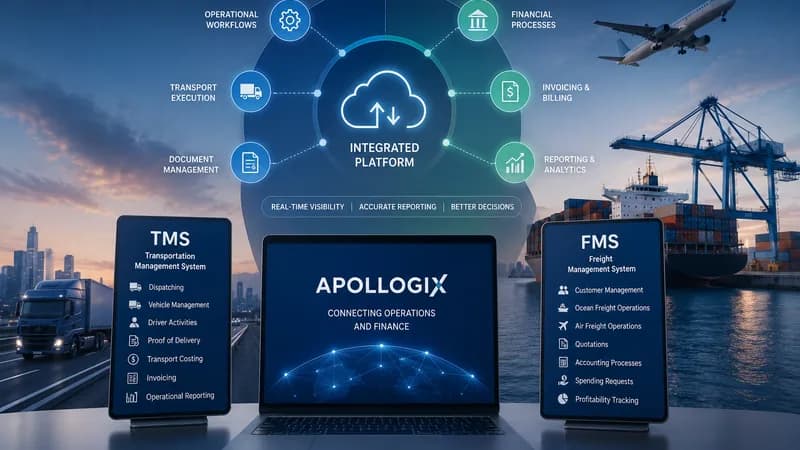
Apollogix provides integrated logistics management through its Transportation Management System (TMS) and Freight Management System (FMS).
Apollogix TMS helps transport companies manage transport quotations, transport orders, dispatch planning, trip execution, fleet utilization, driver management, container management, proof of delivery (POD), GPS integration, accounting, dashboards, and operational reporting.
Apollogix FMS supports freight forwarding companies by managing customer quotations, bookings, ocean freight, air freight, shipments, documentation, accounting, receivables, payables, profitability analysis, dashboards, and management reporting.
Because operational data is shared across departments, businesses reduce manual coordination while improving operational visibility and decision-making.
Where the value appears
Business value appears when transportation, freight forwarding, finance, documentation, and reporting operate from one connected operational platform.
Which Businesses Benefit Most?
Integrated logistics and supply chain management solutions are suitable for freight forwarders, transport companies, warehouse operators, distributors, manufacturers, container carriers, and third-party logistics providers (3PL).
Operations teams gain real-time visibility into shipments and transport execution. Documentation teams process shipping documents more efficiently. Finance teams manage operational costs and invoicing with greater accuracy. Business leaders receive dashboards showing operational workload, service performance, profitability, and business trends.
As supply chains continue to become more complex, integrated logistics management provides the operational foundation needed for scalable and sustainable business growth.