Transportation management covers how a business receives transport demand, creates transport jobs, plans trips, assigns drivers and equipment, tracks execution, records costs, and reports delivery results.
For logistics companies, transportation management is not just about moving goods. It is about controlling daily transport decisions before they become delays, cost leakage, or customer complaints. A Transportation Management System, or TMS, is software that helps companies manage transport jobs, operations, rates, equipment, accounting, reports, and user permissions in one structured environment.
What Is Transportation Management in Logistics?
Transportation management is the process of managing transport activities from order planning to final delivery confirmation.
The practical meaning of transportation management
In daily operations, transportation management starts when a customer requests a movement. The team needs to create a transport job, confirm pickup and delivery points, check container or cargo details, assign the right vehicle, choose the driver, and monitor trip progress.
Without a structured workflow, information can stay inside phone calls, messages, or separate working files. Management may only notice a problem after the vehicle is late, the container is close to demurrage, or the customer asks for an update.
Why this matters for management
For a COO, transportation management gives visibility into trip progress and operational risk. For a CFO, it connects transport activity with revenue, cost, invoice, and payment data. For a business owner, it turns transport from a reactive task into a controlled operating process.
Why Transportation Management Matters for Logistics Companies
Transportation management matters because delivery performance, cost control, customer updates, and fleet usage all depend on the same operating data.
The cost of disconnected transport operations
A transport job can involve many moving parts. The team must manage customer information, depot or warehouse addresses, vessel or container details, ready time, driver allocation, equipment status, waiting time, proof of delivery, and billing data.
When these details are handled separately, small errors can become expensive. A wrong address can delay pickup. A missing ready time can break the daily plan. A vehicle issue can affect multiple trips. A cost item that is not recorded can reduce job margin without being noticed.
Transportation management gives the company a single workflow to follow. It helps teams see what needs to move, who is responsible, which equipment is available, what status has changed, and which cost should be recorded.
The main business risk
The main risk is not only late delivery. The deeper risk is losing control of the transport operation while the business still carries the cost, service promise, and customer relationship.
How Apollogix Supports Transportation Management
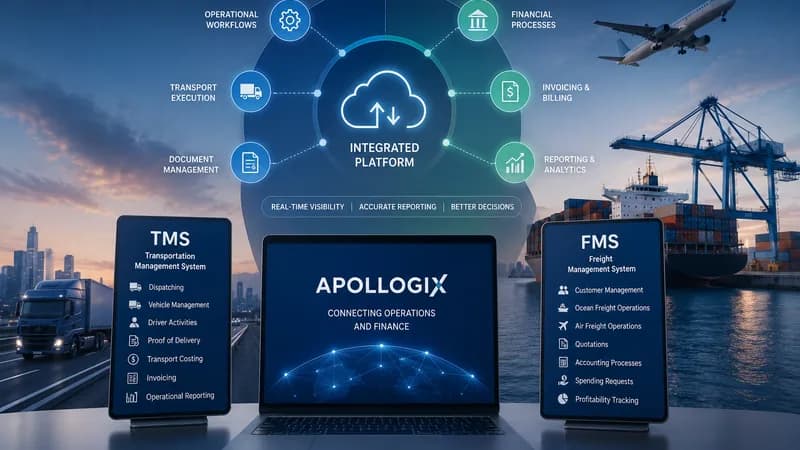
Apollogix supports transportation management by connecting transport jobs, operation planning, driver allocation, equipment data, rate management, accounting, and reporting in one transport workflow.
From transport job to trip execution
In Apollogix TMS, a transport job can be managed by job type, status, customer reference, vessel, voyage, port, ETA, ETD, and available date. The operation workflow then supports daily planning, trip allocation, container movement, driver assignment, and schedule tracking.
The dashboard gives management a view of jobs, containers, trips, drivers, and equipment by status. It also helps track waiting time, trip summaries, container demurrage, proof of delivery, and operational notifications.
Why the workflow is stronger than a task list
A task list only shows what someone needs to do. A transportation management workflow shows how the job, trip, driver, equipment, cost, invoice, and report are connected. This is what helps management control daily execution instead of chasing updates after the problem appears.

What Should a Transportation Management System Include?
A transportation management system should include job management, operation planning, customer data, rate control, equipment management, accounting, reporting, system settings, and user permissions.
Core functions in a transport workflow
The system should let the company manage transport jobs for container and general freight movements. It should store customer, depot, warehouse, shipping line, and partner data. It should support daily operation planning, driver allocation, vehicle and trailer management, and trip status tracking.
A reliable system should also connect commercial and financial data. Rate management helps the company manage customer rates, company tariffs, transport quotation, surcharge rules, waiting time, and other cost items. Accounting then records revenue, cost, accounts receivable, accounts payable, invoice, payment, and financial reports.
Why reporting must be part of the workflow
Reporting should not be a separate task done after operations end. It should come from the same data used during execution. That way, management can review jobs, containers, customers, routes, drivers, costs, and invoices with fewer manual checks.
Which Businesses Need Transportation Management Most?
Transportation management is most useful for transport companies, freight forwarders, 3PL providers, and logistics teams that manage many jobs, containers, drivers, vehicles, and delivery commitments.
When manual control becomes too risky
The need becomes clear when the company handles many trips each day, uses multiple drivers and trailers, manages container free time, tracks waiting time, or needs billing data from actual transport activity.
At that stage, manual control creates too much dependency on individual memory. Management may not know which trips are delayed, which equipment is unavailable, which customer cost should be billed, or which job has not been closed.
A good fit for COO and CFO teams
For COO teams, transportation management gives better control over daily operations. For CFO teams, it connects transport activity with cost, revenue, receivables, payables, and reports. This helps the company see both service performance and financial impact.