How Freight Forwarding SMEs Control Operations With FMS
Freight forwarding SMEs often grow through customer relationships before their internal systems are ready for the added workload. A few shipments can be managed through manual tracking, shared files, and message threads. But when ocean freight, air freight, quotations, services, invoices, and reports start moving at the same time, small gaps become daily pressure. Sales needs accurate customer and rate data. Operations needs shipment status. Documentation needs bill details. Accounting needs cost and invoice data. Management needs a clear view of performance. This is where freight forwarding SME operation software becomes part of the operating structure — not just a place to store data.
Why Freight Forwarding SMEs Lose Operational Control
Freight forwarding SMEs lose operational control when customer data, shipment progress, service charges, and accounting records are managed in separate places.
The daily problem behind growth
Growth creates more than additional shipment volume. It creates more handovers between people. A customer request may begin with sales, move to operations, pass through documentation, and end with accounting. If each team keeps its own file or update method, the same job can have several versions of the truth.
This affects daily decisions. A shipment may already be active, but the related service charge is not updated. A quotation may be approved, but the job order does not clearly show the next handler. Accounting may wait for cost confirmation before issuing an invoice. Management may only see the issue when a customer complains or when profit looks different from the expected margin.
For SME freight forwarders, the risk is not only operational delay. The bigger risk is losing visibility while the business is growing. A structured system helps the company keep customer records, shipment data, service details, job status, and financial records connected around the same job.

What an FMS Changes in Daily Freight Operations
An FMS changes daily freight operations by giving sales, operations, documentation, accounting, and management one shared structure for handling freight jobs.
From scattered updates to connected job data
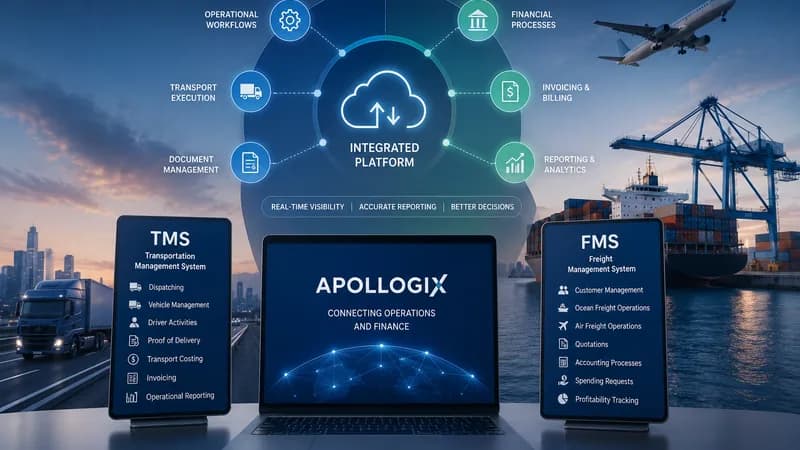
FMS means Freight Management Software. It is software used to manage freight forwarding workflows such as customer records, quotations, shipments, services, accounting, and reporting.
In a freight forwarding SME, the first change is data consistency. Customer, vendor, agent, and partner information can be managed in a shared client database. When teams create a quotation, job order, shipment, or accounting record, they can work from the same client information instead of retyping or checking separate files.
The second change is job visibility. Shipment data can be linked with consol, job order, service, and accounting information. For ocean freight, this can include shipment number, consol number, HBL, MBL, carrier booking, vessel, voyage, POL, POD, and import or export status. For air freight, this can include MAWB, HAWB, airline, flight number, ETD, ETA, and related customer details.
The third change is financial control. Services such as customs, trucking, handling, and other charges can be attached to the job or shipment. This helps accounting create invoices, track receivables and payables, and review revenue or cost by job.
How Freight Teams Work Better With Shared Workflow
Freight teams work better with a shared workflow because each department can update its own part of the job without breaking the connection between operations and finance.
A practical workflow for SME freight forwarders
A freight job usually starts before the shipment is created. Sales may prepare a quotation based on customer, route, freight mode, and local charges. Once the customer accepts, the quotation can become a job order. The job order then gives operations and documentation a clearer starting point.
From there, the shipment record becomes the working file for the team. Operations can track routing, loading, discharge, service requirements, and shipment status. Documentation can manage house bill and master bill details. Service teams can add trucking, customs, handling, or other service items. Accounting can use job and shipment data to create invoices, monitor receivables, manage payables, and review job-level profit.
This workflow matters because SME teams usually do not have a large support layer between departments. The system needs to reduce repeated data entry and make handovers clearer. When job data is connected, teams can spend less time checking who has the latest update and more time managing the shipment.

Where Management Gains Better Visibility
Management gains better visibility when operational data, customer activity, shipment volume, service progress, revenue, cost, and profit can be reviewed from connected reports.
Visibility for COO and CFO decisions
For a COO, the value is operational visibility. The team can review shipment volume, job status, service workload, and progress by type of freight. This helps management understand where the workload is increasing and where follow-up is needed.
For a CFO, the value is financial visibility. Freight forwarding profit depends on how well cost, selling price, receivables, payables, and service charges are captured. If cost data arrives late or sits outside the job record, the company may not see the real margin until after the work is finished.
A connected reporting structure helps management review revenue by customer, shipment output by period, profit by job or shipment, and the mix between ocean and air activity. This does not remove the need for financial review. It gives the review a cleaner starting point because operational and accounting data come from the same job flow.
When an SME Freight Forwarder Should Consider FMS
An SME freight forwarder should consider FMS when daily coordination depends too much on individual memory, separate files, or manual follow-up between departments.
Signs the current process is reaching its limit
The first sign is repeated checking. If sales, operations, documentation, and accounting must ask each other for the same update every day, the workflow is already under pressure. The second sign is delayed invoicing. If accounting cannot issue invoices because shipment or cost data is incomplete, operational gaps are affecting cash flow.
The third sign is unclear job ownership. If a job moves from quotation to shipment without a clear handler, accountability becomes difficult. The fourth sign is weak management reporting. If leaders cannot see shipment volume, customer revenue, cost, and profit without manual consolidation, the system is no longer supporting decision-making.
For SMEs, FMS should not be viewed as a large enterprise system. It should be viewed as an operating layer that keeps freight jobs, customer data, services, accounting, and reports connected as the company grows.